



Two Pair is a strong post-flop hand, but it's one of the most commonly misplayed hands in Texas Hold'em. Players fall in love with it, overcommit when they shouldn't, and fail to recognise when they're already beaten.
Two specific dangers define how you should approach this hand:
- Counterfeit risk. When the card you don't hold pairs on the turn or river, your Two Pair is reduced to one pair with a kicker, and that pair isn't even on the board. Your hand hasn't improved; it's been destroyed.
- Negative implied odds. When you boat up from the bottom, a bigger full house can stack you. The stronger your hand feels, the more it can cost you when you're actually beat.
The core rule with Two Pair: once you've been counterfeited, or once the board shifts against you, let the hand go. The pot you felt entitled to doesn't belong to you anymore.
Here's how to play Two Pair correctly in every major situation.
Flopping Bottom Two Pair
Bottom two pair means you hold both of the two lowest cards on the flop. It's the weakest form of Two Pair and also the most dangerous to play.
Say you get a free look at a flop in the big blind with 3♠️9♥️ and the flop comes 3♥️Q♣️9♠️.
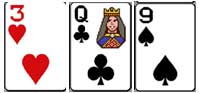
You've flopped bottom two. The Q is the card your opponents are most likely to hold, meaning a bigger Two Pair (Q9 or Q3) is a realistic threat, and a set of queens is possible too. Rule: bet big to protect your hand and get information fast. Don't let draws get there cheaply, and don't let the pot grow passively in a spot where you're already behind.
How Board Texture Changes Everything
Top two pair (holding both of the two highest cards on the flop) is a much safer position. Your opponents are less likely to have your cards, and a stronger hand is improbable. Top two mainly has to fear sets or strong combo draws.
The strength of any Two Pair depends heavily on the board texture – not just which pair you have, but which cards surround it and what your opponents are likely to hold.
Compare the following two flops: 2♥️9♠️K♥️ vs T♠️Q♣️A♥️
On the first flop, bottom two (2 and 9) is in relatively good shape. Despite flopping bottom two, it's pretty unlikely that you are up against a bigger Two Pair or a straight draw. Unless your opponent flopped a set, you are likely way ahead. If your opponent flopped a king, you’re probably going to win a nice pot.
On the second flop, bottom two is in serious trouble. Broadway cards – A, Q, T – are exactly what opponents play pre-flop. Multiple bigger Two Pair combinations are realistic. A flopped straight is possible. Any ace, jack, or king on a later street adds further danger.
Rule: the higher and more connected the flop, the less confident you should be with bottom two, regardless of how strong Two Pair feels in absolute terms.
Flopping Bottom Two vs an Overpair
When you flop Two Pair against an opponent's overpair, you're a strong favourite, but the hand isn't without risk.
Say you have J♠️T♠️ and your opponent has A♣️A♥️. The flop comes T♦️2♥️J♣️
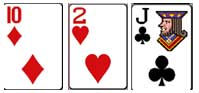
According to Poker Cruncher, JT is 73% to win by the river.
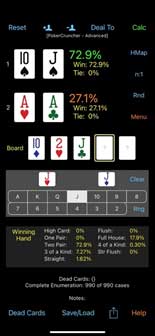
AA has five outs: the remaining aces and the deuces. If an ace comes, AA makes trip aces; if a 2 comes, AA improves to two pair (Aces and deuces). In both situations, AA takes the lead. JT can also lose the hand if the turn and the river are the same card (unless they are a T or J, of course!).
Rule: the lower your Two Pair, the worse your negative implied odds against overpairs. Sixes and sevens face many more overpairs than jacks and tens, and getting counterfeited is far more likely.
Absolute vs Relative Strength
Absolute strength is how a hand ranks in isolation. Two Pair beats one pair, trips beat Two Pair, and so on. In absolute terms, flopping Two Pair is a good result because it beats most hands your opponents can hold.
Relative strength is how your hand compares to the specific board and your opponent's likely poker hand range right now. A Two Pair that's strong in absolute terms can be nearly worthless in relative terms.
Example: the board runs out with three spades and you face a large river bet holding bottom two (no spade). Your absolute hand is Two Pair. Your relative hand is a bluff-catcher at best – and probably a fold.
Rule: always evaluate both. Absolute strength sets the baseline; relative strength determines the action.
Odds of Flopping Two Pair
Starting with an unpaired hand, the probability of flopping Two Pair is approximately 2% – once in roughly 50 hands.
- In a live game (around 25 hands/hour), you'll flop Two Pair roughly once every two hours.
- Online (around 60 hands/hour at a full table), it happens slightly more than once per hour.
With four players seeing the flop on average, someone at the table flops Two Pair from an unpaired hand approximately every 15 minutes live and every five minutes online. Top two is more frequent than bottom two, because higher cards appear in pre-flop ranges more often.
Two Pair – Basic Strategy
The key variable in playing Two Pair is implied odds – both yours and your opponent's. Stack depth is the primary factor that determines how to proceed.
Short stacks: Two Pair is strong enough to play for the effective stack immediately. Get it in before draws get there and before the board changes.
Deep stacks: The gap between top two and bottom two becomes much more significant. With deep money behind, opponents can profitably call with sets or strong draws, and the river can be expensive. Play cautiously with bottom two, and consider the full range of hands that could beat you.
Fold bottom two when any of the following apply:
- The board completes a flush or straight
- A turn or river card counterfeits your Two Pair
- Your opponent shows willingness to play for full stacks on a board that favours their range
In poker tournaments near the bubble, add an extra layer of caution: a mistake with bottom two can end your run. On paired, three-suited, or highly connected boards, the default is to keep the pot small and re-evaluate each street.
Key Takeaways
Flopping Two Pair is usually a good result, but it carries real vulnerabilities that most players underestimate. The best sign you're playing it well is when you can identify that your hand is no longer good and find the fold.
One final note: loose players flop Two Pair far more often than tight ones, simply because they play more hands. If a loose-passive player suddenly bets hard, don't dismiss the possibility: they hit Two Pair on boards you wouldn't expect, and they'll gloat about it. Play better than they do and you'll win their money over time.
- Bottom two pair is the most vulnerable form of Two Pair. Bet to protect it and gather information quickly.
- Board texture determines how strong your Two Pair actually is. Low, dry boards are safer than high, connected, or suited ones.
- Counterfeit risk is the biggest hidden danger. When the non-held card pairs the board, re-evaluate immediately – your hand may now be garbage.
- Absolute strength ≠ relative strength. Two Pair is a good hand; it's not always a good hand right now.
- Stack depth is the key strategic variable. Short stacks: get it in. Deep stacks: proceed with caution, especially with bottom two.
- Know when to fold. Releasing Two Pair on the right board is a mark of a strong player.
- Odds of flopping Two Pair from an unpaired hand: ~2% – roughly once every 50 hands.
