



In No-Limit Texas Hold'em, there are 169 distinct starting hands – 13 pocket pairs, 78 suited hands, and 78 unsuited hands. Of those, a small subset stands apart as premium: hands strong enough to play from any position and profitable over the long run.
What Are Premium Poker Hands?
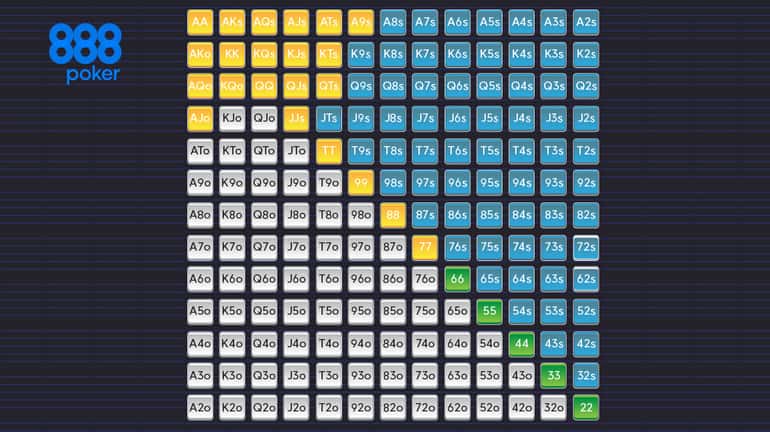
Premium poker hands are generally defined as the top 10% of all starting hands. That works out to 22 possible combinations: pocket pairs of sevens or better (77+), big suited aces down to A9s, and big offsuit combos from KQo upward.
A stricter definition limits "genuine" premium hands to those that can withstand a three-bet from any position – think pocket tens or better plus big suited aces like A♠️K♠️ or A♥️Q♥️. These hands have a positive expectation over time and don't need favourable position to be profitable.
Position matters. QTo, for instance, is marginal from early position but a clear open from the button. Factors like stack depth and the number of players at the table also affect what qualifies as premium in a given situation.
Top 10 Poker Starting Hands
Starting from the strongest, the broadly agreed top 10 hands in Texas Hold'em are:
- Pocket aces (A♠️A♥️)
- Pocket kings (K♠️K♥️)
- Pocket queens (Q♠️Q♥️)
- Pocket jacks (J♠️J♥️)
- Ace-King suited (A♠️K♠️)
- Pocket tens (T♠️T♥️)
- Ace-Queen suited (A♠️Q♠️)
- Ace-King offsuit (A♠️K♥️)
- Pocket nines (9♠️9♥️)
- Ace-Jack suited (A♠️J♠️)
Pocket pairs generally rank higher than non-pair holdings of equivalent strength because they don't need to pair the board to make a hand; they're already ahead of most unpaired holdings preflop.
How Rarely Are Premium Hands Dealt?
Premium hands are rare enough that waiting for them is a significant constraint on your win rate. Key odds to know:
- Pocket aces: 220-to-1
- AK suited or offsuit: 81.9-to-1
- Pocket tens or better: 43.2-to-1
- Suited jack or better (JTs, QJs, etc.): 54.3-to-1
These figures explain why tight players can go long stretches without a playable hand and why patience is both a virtue and a vulnerability at the poker table.
Why Hand Selection Matters
Building good habits around starting hand selection is one of the first and most impactful adjustments a new player can make. Playing only premium hands creates a tight, solid image that earns respect. Opponents are less likely to bluff into you or call your bets lightly when they know you play few hands.
That said, premium hands don't guarantee wins. Pocket aces, the best starting hand in the game, still lose roughly 20% of the time heads-up against any random holding. Suited connectors like 8♠️7♠️ can actually have around 24% equity against aces – more than kings do!
Post-flop awareness is equally important. A hand like A♦️K♦️ is premium before the flop, but on a board of 8♠️9♠️T♣️ it becomes near-worthless. Recognising when a strong starting hand has been neutralised by the community cards is as important as knowing which hands to play in the first place.
Flop Odds for Premium Hands
Understanding how often your premium hands improve after the flop helps set realistic expectations.
Unpaired hole cards
- Flop a pair: 26.9%
- Flop two pair (using both hole cards): 2.0%
- Flop trips: 1.3%
- Flop a full house: 0.09%
- Flop four-of-a-kind: 0.01%
Pocket pairs
- Flop a set: 10.8%
- Flop two pair (board pairs): 16.2%
- Flop a full house (set + paired board): 0.7%
- Flop a full house (trips on board): 0.2%
- Flop four-of-a-kind: 0.2%
Suited hole cards
- Flop a flush draw: 10.9%
- Flop a flush: 0.8%
Offsuit connected cards (e.g. JT, QJ)
- Flop a flush draw: 2.2%
- Flop a straight: 1.3%
When Playing Tight Becomes a Weakness
A premium-hand-only strategy creates predictable patterns that observant opponents will exploit. If you only raise with strong hands, they'll fold every time you show aggression, and you'll win small pots. They'll also raise you more liberally in position, knowing your poker range is narrow.
When you're at a table full of tight players waiting for big hands, the right adjustment is to open wider and steal blinds more often. The odds against being dealt a premium hand mean those pots are up for grabs far more often than most players realise.
Deep in tournaments, premium-hand confrontations become frequent precisely because tight play is more common. That's where you see the classic flips (AK vs QQ), coolers (KK vs AA), and cracked big pairs that define deep runs.
Key Takeaways
- Premium hands are the top 10% of starting hands: 77+, QTo+, KQo+, A9s+, and AJo+.
- The strictest definition covers hands that can be played profitably from any position: TT+, AQs+, and AKo.
- Pocket aces are dealt once every 221 hands; TT or better once every 43.
- Even the best starting hands lose. Aces win roughly 80% of the time heads-up, not 100%.
- Flop texture always matters: a premium preflop hand can become a clear fold on the right board.
- Playing too tight makes you exploitable. Premium hand strategy works best when combined with selective aggression.
