

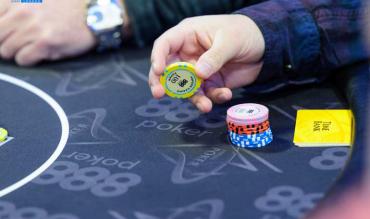

Beating a poker maniac comes down to patience and position. Sit to their direct left, fold your marginal hands without a fight, and wait for genuine strength. When you have it, let them keep betting into you. A maniac will hand you their stack far more often than they take yours.
Every table gets one eventually: the player raising three hands in a row, firing at every flop and apparently allergic to folding. It’s a style that frustrates almost everybody who faces it, which is exactly why it keeps working. Here’s how to stop it working against you.
How Do You Spot a Poker Maniac?
Playing styles get labelled fast, and the poker terms for each one stick. Reserved, cautious players are called tight, or nits. Players who enter few pots but attack hard when they do are “TAGs”, short for tight aggressive. Players who enter a lot of pots and attack anyway are “LAGs”, or loose aggressive. A maniac sits at the far end of that scale: the loosest and most aggressive player in the room, usually without the finesse that makes aggression pay.
A TAG might only play the top 10 percent of hands preflop. A maniac plays a far wider range, betting, raising and stubbornly refusing to give up on a hand. They go big or go home, so they’re either out early or sitting behind a mountain of chips.
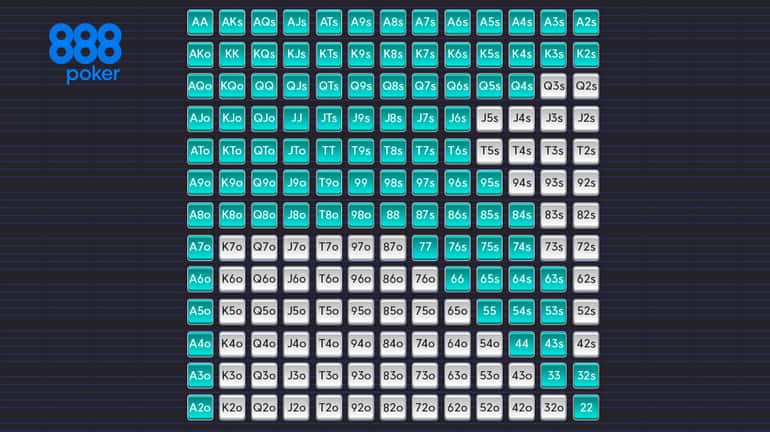
A LAG will play a wide range, roughly the highlighted hands below:
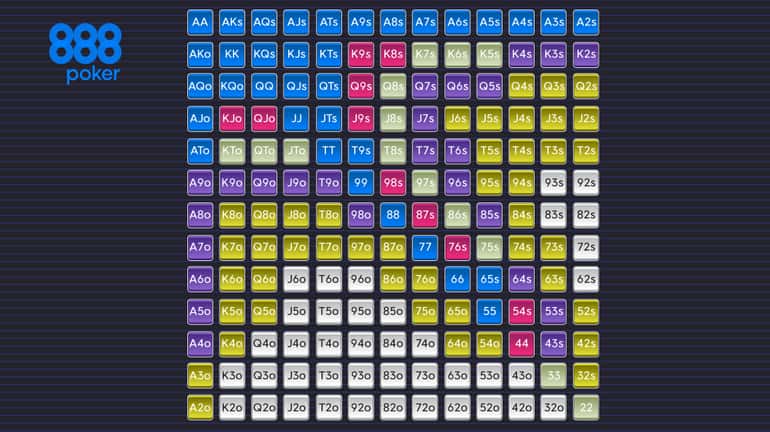
A maniac goes wider still, adding the hands below, and often the junk that isn’t highlighted at all:
One distinction matters more than any other. Work out whether you’re facing an unsophisticated maniac (reckless, no apparent regard for the size of the pot, missing the fundamentals) or a deeper-level maniac, a solid player using an extreme style on purpose. The second type is far more dangerous, and will shift gears the moment you adjust to them.
Where Should You Sit Against a Poker Maniac?
Position is power in poker. Picture two 888poker Ambassadors at the same poker table, one in Seat 3 and one in Seat 4. The player in Seat 4 sits to the direct left of Seat 3 and acts after them on every street. Seat 3 has to act first, without knowing what’s coming behind.
So where’s the best seat against a maniac? Directly on their left, without question. From there, position cuts both ways in your favour. Holding bad cards, you fold to their raises and lose nothing.
Holding good cards, you simply wait. Let the maniac do the work while you sit on premium holdings. There’s no need to get creative with weak hands. Tighten up, and when the maniac raises into your strong one, three-bet. You’ll either pick up an inflated pot uncontested or play a big one with the best of it.
Out of position against a maniac, proceed carefully. Don’t get involved with weak holdings, because you’ll be raised off them. With a strong hand, consider slow playing to set a trap.
How to Play Against a Poker Maniac After the Flop
Assume the maniac defends and you’re playing postflop. You need a plan before the flop lands, or you’ll get blown off the hand.
Say the maniac raises, you three-bet in position with A♦️K♠️, and the flop comes 7♣️8♥️10♠️.
- What do you do if they lead out?
- Do you bet if they check?
A maniac plays any two cards, so their range connects with that board in dozens of ways and it has missed you completely. If they lead out, fold. If they check, take the free card.
Now change one thing and give yourself pocket aces on the same board. It’s a scary texture, but giving up on aces that easily is expensive. You could raise, and find out they actually have it. Against a maniac, lean towards gambling in thin spots. You’ll be ahead of their range far more often than not, and sacrificing that equity costs you. Show a maniac you won’t defend your strong hands and they’ll sense it, then put you to the test every orbit.
Change it once more: you hold aces, the flop brings an ace, and your opponent leads out. Calling keeps them firing on the turn. Raising scares them off. Board texture and stack sizes decide it, but as a general rule, play your monsters weak and passively against a maniac and give them room to bluff off their chips.
If they’re betting, they’re building the pot for you. Let them. If they check, bet, and charge them to see another card. Occasionally you’ll get the dream scenario, where the maniac wakes up with a check-raise while you’re holding the goods.
How Do You Get a Poker Maniac to Fold?
Sometimes you want them gone. Top set on a draw-heavy board texture is the classic case, where you’d happily take the pot down right now. Getting a maniac to fold is hard work.
With any piece of a hand they turn stubborn, holding on tighter than a dog to a bone. Small bets achieve nothing. You need big bets and raises to make a maniac think twice about continuing. If there’s a flush draw out there, size so you’re not offering a reasonable price to chase it, and don’t be afraid to go all in to shut the hand down.
There’s a cruder version of the same idea. Some players never get comfortable against a maniac, usually because they’re afraid of having big hands cracked. Facing a raise with jacks, queens, kings or aces, they re-raise enormously (four times the raise or more) or move all-in. It gives up value, but it’s the ultimate show of strength and it will deter any sane maniac.
Use it as an escape hatch, not a strategy. Players who can’t adjust have two options against a maniac: stay out of their way, or throw out a speed bump big enough that they steer clear of you. Everybody else should take the free lesson and learn to play back.
Should You Play Like a Poker Maniac?
Whether you plan it or not, you’ll build an image at the table. The longer you’re in action, the more your opponents learn. They see how you play, which hands you show down, and they build a profile of you whether it’s accurate or not. Strong players know this and work to manipulate it.
There’s plenty you can do deliberately:
- What you wear. Sunglasses and headphones advertise a serious player who isn’t there for the conversation.
- Which hands you show down. Voluntarily flashing winners you didn’t have to show pushes the table towards thinking you only play premiums.
The strongest version of this is building a maniac image while playing tighter than anybody realises. Players pay off a maniac, after all, they could turn up with anything. To get there, play loose and aggressive early, when pots are cheap and the damage is limited. Then shift gears once stacks get deeper or the tournament progresses, tightening up and waiting for quality hands. Until the table catches on, you’re still being paid like a maniac.
Maniacs are both fun and frustrating, and there’s no denying they change the dynamic of any game they sit in. However the session ends, remember that a maniac has exactly the same right to play two cards any way they like as you do.
Key Takeaways
- A maniac is the loosest, most aggressive player at the table, usually without the control to make that aggression profitable.
- The best seat is directly on their left, where you act after them on every street.
- Fold your marginal hands without a fight, especially out of position.
- Play big hands slowly and let the maniac build the pot for you.
- Folding out a maniac takes large bets and raises, never probing ones.
- Check whether you’re facing a reckless maniac or a skilled player using the style on purpose. The second will shift gears on you.
